Jurema PretaMimosa tenuiflora
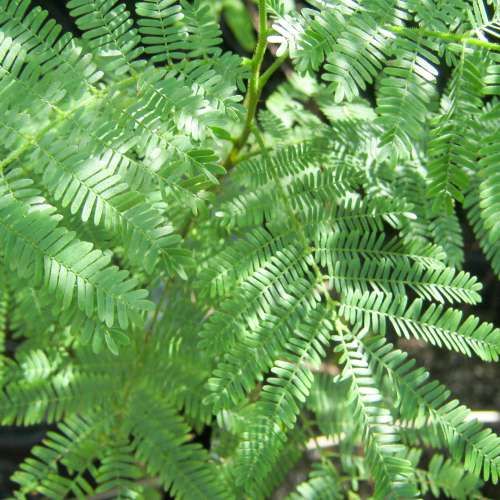
A jurema preta tree in fresh green leaf in the Caatinga after the first rains The same kind of tree in the dry season: thorny branches, few leaves, cream flower spikes and pods

Mimosa tenuiflora, syn. Mimosa hostilis · Caatinga, north-east Brazil

Jurema preta, a dry-forest tree through the year

A guide to jurema preta (Mimosa hostilis): how to recognise the tree, grow it from seed in Europe, its Caatinga seasons, tradition, bark dye and the law.

April in Santa Terezinha, Paraíba: every tree in the sample in full green leaf, the first flower buds showing.August in Santa Terezinha, Paraíba: 20 % of crowns green, 40 % in flower, 60 % carrying ripe pods. Azevêdo et al. 2014

In the rainy season

  • 3 to 5 monthsThe Caatinga gets most of its 300 to 1000 mm of yearly rain in this window, and the amount varies wildly between years.Sampaio 1995
  • 80 %of the sampled trees carried green, young leaves in December, at the start of the rains.Azevêdo et al. 2014
  • 100 %were in full green leaf by April, at the end of the rains, with the first flower buds.Azevêdo et al. 2014
Jurema preta in the dry season, with thorny branches, cream flower spikes and pods

In the dry season

  • 70 %of the sampled trees had dry leaves or none in August, at the start of the dry season.Azevêdo et al. 2014
  • Aug to Novis the normal flowering season in Paraíba: the tree flowers when it is driest.Maia 2004, in Azevêdo et al. 2014
  • 60 %carried ripe pods a year later in August; the seed falls mainly by gravity.Azevêdo et al. 2014; Embrapa

One year, measured

Share of jurema preta trees with each feature at Santa Terezinha, Paraíba, sampled every three months. The highlighted months belong to the season you have switched on.

Feature Aug 2008start of dry seasonDec 2008start of rainsApr 2009end of rainsAug 2009dry season
Green leaves 30 %80 %100 %20 %
Dry leaves 70 %0 %0 %20 %
Flowers 0 %0 %10 %40 %
Ripe fruit 0 %0 %0 %60 %

Source: Azevêdo, Paes, Calegari and Nascimento, Revista Brasileira de Ciências Agrárias 9(1), 2014, table 1. Ten trees per sampling date.

From seed to tree

Five stages, with the timings measured in Brazil and Mexico. Scroll to grow the tree.

  1. Day 0

    Seed 3 to 4 mm

    Oval, flat and light brown, about 110,000 to the kilo. The coat keeps water out: in one trial only 5 % of untreated seeds came up.

    Embrapa; Benedito et al. 2017

  2. 1 minute

    Scarified seed 72 hours

    One minute in boiling water, or a nick in the coat. After 72 hours in water, 60 % of treated seeds showed a root tip, against 8 % of untreated seeds.

    Embrapa; Benedito et al. 2017

  3. 5 to 10 days

    Seedling 3 to 5 cm

    Treated seed sown in warmth emerges in 5 to 10 days. Prick out after one to two weeks, or at 3 to 5 cm, into a deep pot: the taproot forms early.

    Embrapa

  4. 12 to 14 weeks

    Sapling 3 months

    The first fully adult, twice-divided leaf appears in weeks 12 to 14. In a nursery the plant is ready to plant out about three months after sowing.

    Camargo-Ricalde and Grether 1998; Embrapa

  5. 5 years

    Tree about 4.5 m

    In the wild the tree reaches about 4.5 m at five years; the largest trees approach 7 m with a trunk of 30 cm. In a pot it stays far smaller.

    Azevêdo et al. 2014, citing Maia 2004; Embrapa

Read the full growing guide

Jurema preta is Mimosa tenuiflora, a thorny tree of the legume family from the Caatinga, the dry forest of north-east Brazil. Older books and most shops call it Mimosa hostilis. It grows to about 7 metres, fixes nitrogen through bacteria in its root nodules, and is one of the first trees to colonise cleared or eroded ground (Embrapa).

This site covers the tree as a tree. You can read how to recognise it, what it does through the Caatinga year, how to raise it from seed on a European windowsill, the place of jurema in north-east Brazil, and why the bark has long been used for dye and leather. The root bark also contains DMT, a controlled substance almost everywhere, which is why the legal page matters before you order anything.

Start with seeds

A packet of seeds is the simplest way to get to know the tree. The seeds are 3 to 4 mm long and have a hard coat that keeps water out, so untreated seed germinates poorly. In a Brazilian trial only 5 % of untreated seeds produced a seedling (Benedito et al. 2017); in a Mexican trial nicking the seed coat raised germination from 24 to 36 % to 84 to 89 % (Camargo-Ricalde and Grether 1998). Treated seed sown in warmth emerges in 5 to 10 days.

Which to choose

If you want toChooseWhy
try one or two plants on a windowsillMimosa hostilis seeds, 10 per packetenough for a few attempts; the shop describes the tree as drought resistant, nitrogen fixing and rich in tannin
sow in a cool room or in early springseeds plus the small heating matgermination is fastest around 25 °C; at 20 °C it is slower
raise a tray of seedlingsseeds plus the large heating matroom for several pots at once
dye wool or cotton, in the Netherlandsinner root barktannin-rich bark, sold by the shop as a dye material and botanical specimen, not for consumption, 18+

Seeds and heating mats can be ordered from Avalon Magic Plants in the Netherlands. The root bark is offered here only for readers in the Netherlands, where the plant is not on any drug list; it is not for readers in the UK, the US, France or Germany. The legal page explains why, country by country.

Where to go next

The tree's year is the thread through this site. Use the switch at the top to see the same forest in the dry season and the rainy season. The seasons page explains what changes and when, with the measurements behind it, and the growing guide turns that rhythm into a care plan for a pot in a European house.

Field stations

  1. 01The treeBark, thorns, feathery leaves, white flower spikes and small pods: how to tell jurema preta apart, where it grows wild and what its names mean.
  2. 02SeasonsThe Caatinga gets most of its rain in three to five months. How jurema preta drops leaves, flowers, fruits and leafs out again, with field measurements.
  3. 03Grow from seedScarify the hard seed, sow at 25 °C, prick out at 3 to 5 cm and keep the plant warm and bright: a sourced guide to raising jurema preta indoors.
  4. 04TraditionIn north-east Brazil, jurema names a tree, a ritual drink, ceremonies and a spirit world. Who keeps the tradition, how it was recorded, how Paraíba protects it.
  5. 05Bark and dyeJurema preta bark is rich in tannins and has long been used to dye cloth and tan leather. What the measurements show, and where the root bark may be sold.
  6. 06The lawThe tree is rarely named in drug law; the DMT in its root bark always is. Seeds, plants and bark in the UK, US, Netherlands and EU, checked 15 October 2026.